

Starting a career in the nail industry usually comes down to four things: learning the fundamentals properly, getting comfortable with enhancements like acrylic and gel, practicing on real clients before you’re on your own, and understanding the business side early. Most people who struggle in their first year skipped one of these, not because they lacked talent, but because they went straight from hobby to job without the parts in between.
Learn the fundamentals properly
Manicures and pedicures look simple from the outside, but there’s real technique underneath: nail shaping, cuticle work, sanitation, understanding what a client’s nails and skin can actually handle. Skipping straight to nail art without this foundation tends to show up later as inconsistent, uneven work that doesn’t hold up.
Get comfortable with enhancements
Acrylics, hard gel, PolyGel, Gel-X — each enhancement system behaves differently, and clients will ask for all of them. Knowing one well and guessing at the rest limits how many clients you can actually take. This is usually the most technical part of training, and it’s worth taking seriously rather than rushing through.
Practice on real clients before you’re on your own
Doing your own nails, or a friend’s, is different from managing a paying client’s expectations, timeline, and the occasional awkward feedback. Programs that include real client hours — not just practice hands — tend to produce technicians who are far less rattled in their first weeks on the job.
Understand the business side early
Whether you end up employed at a salon or running your own chair or studio, nail work is still a business: booking systems, retail upselling, pricing your time properly, managing repeat clients. A lot of technically skilled nail artists underprice themselves for years simply because no one taught them this part.
Decide how you want to work
Salon employee, commission-based chair rental, or fully independent — each comes with different trade-offs in stability, income ceiling, and flexibility. It’s worth thinking about this early, since it can shape which training and certifications are actually worth prioritizing.
Keep building after you’re hired
Nail trends and enhancement systems shift constantly. The technicians who stay in demand keep adding new techniques — new nail art styles, new systems as they come out — well after their initial training ends.
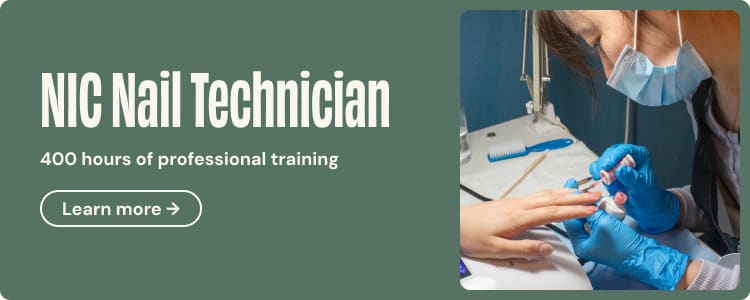
This is the general shape of it; how fast someone moves through these steps depends a lot on the program. At NIC, our Nail Technician program runs 400 hours over 20 weeks, covering manicures, pedicures, acrylics, and gel systems including PolyGel and Gel-X, with real client experience at NIC Spa built in from early on. Find out more →